
JungIreland

NBA Spread Betting

NBA spread betting is a bet on the margin of victory. The favourite must win by more than the spread, while the underdog covers by losing by less or winning outright.

See Spreads
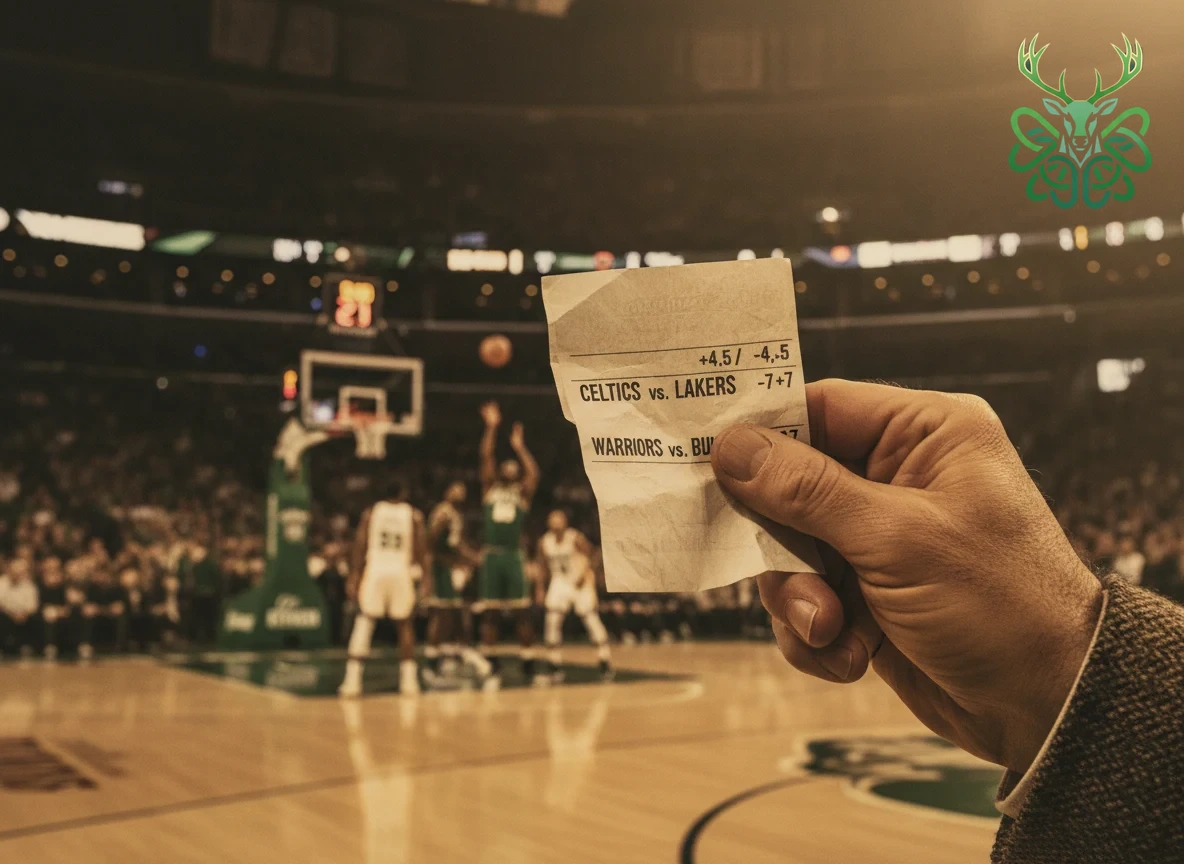
Phone screen with a basketball point spread slip, header for NBA spread betting

How Is a Point Spread Read?

A spread line has two parts: the points and the price. In "Celtics -6.5 (-110)", Boston must win by 7 or more, and a $110 stake returns $100 profit.
Final marginFavourite -6.5Underdog +6.5
Favourite wins by 10WinsLoses
Favourite wins by 6LosesWins
Underdog winsLosesWins
A whole-number spread, such as -6, can end in a push. If the favourite wins by exactly 6, both sides get their stakes back.

Are Spread and Handicap Betting the Same?

In North America, "spread" and "point spread" mean the same bet. The favourite carries a minus sign and the underdog a plus sign. Both sides are usually priced near -110.
European sportsbooks call the same bet a handicap. An Asian handicap adds quarter lines such as -5.25. Half the stake goes on -5 and half on -5.5, so a margin of exactly 5 returns half the stake and loses the other half.

Which Spread Markets Go Beyond the Full Game?

  • Alternate Spreads

    Buy points for a shorter line at a worse price, or take more points at a better one.

  • Half and Quarter Lines

    First-half and quarter spreads isolate part of the game, which suits teams with strong starters.

  • In-Play Spreads

    Spreads shift during play. More on that in the live spread markets guide.

Why Do Big Favourites Fail to Cover?

Large NBA spreads carry a specific risk: garbage time. A favourite leading by 20 often rests its starters in the fourth quarter. Bench players then let the underdog close the gap. That is why a spread of -12 or more is harder to cover than it looks. Check the rotation habits of both coaches before backing a big favourite. Some coaches empty the bench early, others keep starters in longer.

Do ATS Records and Public Money Matter?

Against-the-spread (ATS) records show how often a team covers. A team can win often yet cover rarely when the market expects a lot from it. Small samples mislead, so a dozen games says little.
Public money tends to favour popular teams and big names. When most tickets land on one side but the line moves the other way, larger bets are usually behind it. Splits are covered in more depth under NBA public betting percentages.

What Is a Simple Routine Before a Spread Bet?

Read the News
Check the injury report and rest status for both teams.
Shop the Line
Compare the spread at two or three sportsbooks for the best number.
Bet and Record
Place the bet at a fixed stake and log the closing line.

How Do Rest and Back-to-Backs Affect Spreads?

Teams playing the second night of a back-to-back often rest stars or play tired legs. Spreads adjust once the rest news is official. The timing matters. A bettor who expects a star to sit can take the line before the announcement, at the risk of being wrong. Waiting for the injury report gives certainty but a worse number. Road trips with several games in a few nights add to the effect.

How Much Is Home Court Worth on the Spread?

Home teams usually get a few points of credit in the spread. Travel, crowd support and familiar surroundings explain part of the edge.
Home-court value has shrunk in recent seasons and varies by team and arena. High-altitude venues such as Denver and Utah are often thought to add a little more. Sportsbooks already include this in the line, so it is no reason to back the home team on its own.

Which Spread Mistakes Are Most Common?

  1. Ignoring the Price

    Taking -6 at -115 when -5.5 at -110 is available elsewhere.
  2. Stale Lines

    Betting before checking whether a star was ruled out an hour ago.
  3. One-Game Overreaction

    Backing a team only because it covered by 20 the night before.
  4. Chasing Losses

    Doubling stakes on the late game to recover an early loss.

How Do Spreads Change in the Playoffs?

Playoff spreads are usually smaller than regular-season ones, because teams are closer in quality. Many games are priced within five points. Adjustments between games matter more. A team that lost Game 1 by 15 often sees a smaller spread in Game 2, as the market expects a response. Starters play heavier minutes, which reduces the garbage-time effect on big spreads.

Check Tonight's Lines

Full-game, half and quarter spreads for tonight's NBA schedule.
View NBA Spreads

Spread Betting Questions

  1. What does +7 mean in NBA betting?

    A spread of +7 means the underdog covers if it loses by 6 or fewer points or wins outright. A loss by exactly 7 is a push, and the stake is returned. A loss by 8 or more means the bet loses. The plus sign always marks the team receiving points. The price next to the line, often -110, decides the payout.
  2. Why is the spread price usually -110?

    The -110 price is the sportsbook's margin on a spread bet. Both sides are priced so the book earns a commission whatever the result. A bettor must win about 52.4% of bets at -110 to break even. Some sportsbooks offer reduced prices such as -105, which lowers that threshold to about 51.2%. Over hundreds of bets, that gap adds up.
  3. Is buying half a point worth it?

    Buying half a point moves the spread in the bettor's favour for a worse price. For example, -6.5 at -110 might become -6 at -120. It is worth it only when the result often lands on that exact number. In the NBA, margins spread out widely, so bought points are rarely worth the extra cost. A simple test is to compare the extra price with how often games land on that number.
  4. How does a basketball teaser work?

    A basketball teaser moves the spread by a set number of points on every leg, often 4 or 5. In exchange, all legs must win, as in a parlay, and the payout is lower. Teasers turn two favourites into smaller favourites or underdogs. They suit bettors who expect close games rather than blowouts. Payout tables differ between sportsbooks, so the same teaser can pay differently.
  5. How big are NBA spreads usually?

    Spreads on regular-season NBA games often range from 1 to 10 points. Mismatches between top teams and rebuilding sides can push them into the teens. Playoff spreads are usually tighter, since teams are closer in quality. A pick'em means the spread is zero and the bet works like a moneyline. Spreads also shrink or grow quickly when a star's status changes.
  6. Does overtime count for NBA spread bets?

    Yes, NBA spread bets include overtime unless the market says otherwise. A tied game after four quarters goes to a five-minute overtime, and those points count. A favourite can cover only in overtime, or fail to cover after leading late. Quarter and half spreads ignore overtime entirely. The market rules on the bet slip confirm which periods count.
  7. When is the spread better than the moneyline?

    Spread bets are usually the better choice when the favourite's moneyline is very short. Backing a team at -400 risks a lot to win a little. The spread offers a price near even money in exchange for a margin requirement. For close games, the moneyline and spread carry similar risk. Comparing the two prices for the same team shows which one offers more.
  8. How is a spread bet placed online?

    Online spread bets are placed by choosing the game, clicking the spread price and entering a stake. The bet slip shows the line and potential payout before confirming. If the line moves while the slip is open, the sportsbook asks to accept the new number. Settlement happens shortly after the final buzzer.